

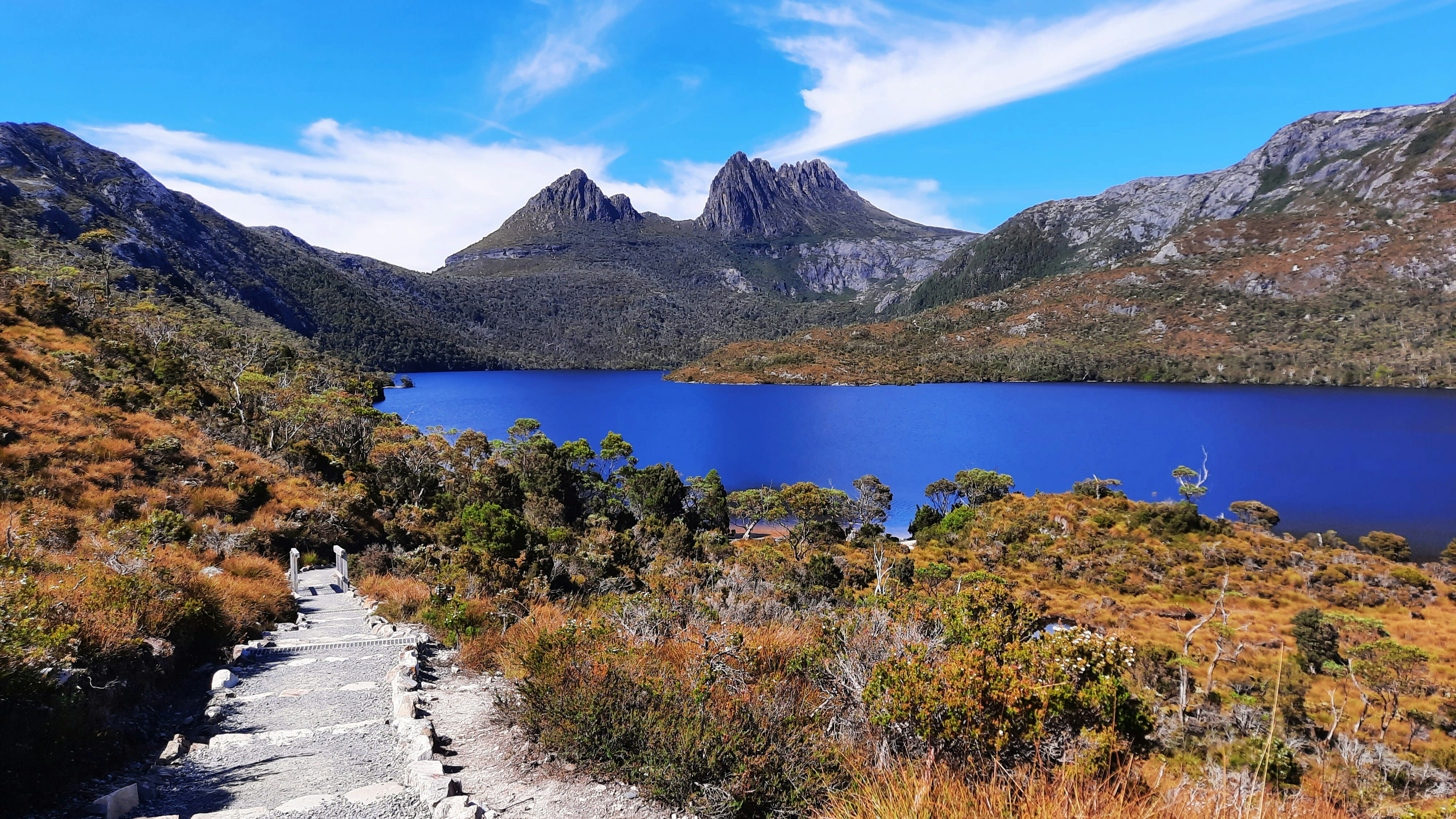
Recently my wife and I enjoyed a wonderfully restful holiday in Tasmania. We walked around Dove Lake and looked up at the towering slopes of Cradle Mountain. We stayed in a remote homestead near Strahan with spectacular views over Macquarie Harbour. In Launceston and Hobart, we enjoyed warm hospitality in the homes of the Lord’s people. We saw, tasted and enjoyed God’s wonderful goodness.
When I describe our holiday in this way, this is not simply Christian jargon which describes everyday pleasures in weird, religious language. This is how things really are, because God reveals himself in his creation. As Christians we believe that, just as truly as God reveals himself in the Bible, he also reveals himself in the world around us. The world of nature is also God’s book. But how skilled are we at reading this book?
Many of us remember how much time and effort we put into learning how to read literal books. We learned the alphabet, many new words, and how those words are joined together to make sentences. As we progressed, we learned how to recognise metaphor and irony, knowing when a writer is to be taken literally and when not. These skills take many years to learn.
One of the reasons why Christians are keen to learn the skills of reading is so that they might read the Bible. This too requires a range of skills which take time and require some effort to learn. We learn about the different books of the Bible and how to compare one passage with another in order to unlock the richness of God’s word.
But how do we train ourselves to see God at work in the world around us? Perhaps we have never asked that question. One of the reasons why we don’t invest much time in learning how to read the book of nature is because it does not show us the way of salvation. Only God’s revelation in Jesus and the Bible can do that.
Nevertheless, nature does show us God’s glory. Psalm 19:1 tells us that “the heavens declare the glory of God.” The rain and sunshine declare God’s goodness and generosity, even to those who treat him with contempt (Matthew 5:45; Acts 14:17). The beauty of creation shows us God’s wisdom and attention to detail. The vastness of the universe declares his immensity and majesty.
In his account of the Arab revolt during the First World War, T. E. Lawrence (better known as Lawrence of Arabia) describes the moment when he and his companions emerged from a rock canyon into the vast expanse of Wadi Rum (in what today is southern Jordan). The rugged beauty of the landscape overwhelmed him with a sense of wonder. Lawrence describes how the “vast, echoing, God-like” landscape impressed them with a sense of their own insignificance. Lawrence does not tell us what that experience taught him about the magnificence of God. But how would we have described it? How do we read the book of nature and share its lessons with others?
A first step is to pause and look at the world around us. That often requires us to stop what we are doing and take time to observe God’s creation. When Jesus urged his disciples to “come away … to a desolate place and rest a while” (Mark 6:31), the setting was the Galilean countryside. They needed rest that restores the soul. They enjoyed that rest in the presence of Jesus; but note that the setting was also significant. The rest they enjoyed enabled them to observe the works of God and admire his wisdom.
It is not only in the countryside that we can see God’s beauty and wisdom. We can see the beauty of God’s wisdom in towns and cities as well. When I walk through the Melbourne CBD my attention is often captured by the bright signs and shop windows. But when I look up above street level, to the upper stories of many buildings, it is amazing what intricate design is hiding in plain sight. We can see God’s wonders not only in birds’ nests and beehives but also in buildings. An example is the beauty which David admired when he went to worship in the Temple in Psalm 27:4. Do we take time to stop and look?
A second step is to talk about what we see with others. Many of us meet regularly to study God’s word and share what we have learned with others. That is a great blessing because God’s word shows us the way of salvation and sanctification. But surely, in our times of fellowship, we can also talk about what we learn as we read God’s book of nature. Perhaps if we heard each other talking more about this book we would grow in our skill at reading it.
A third step is to praise God because of what we see and learn. That happens when we put our breathless wonder into words. That is what David did when he looked at the night sky and saw the moon and stars. Like Lawrence of Arabia, he saw his smallness and frailty, but he was also struck by the fact that the creator of the universe cared about him (Psalm 8:3–4).
When I look at your heavens, the work of your fingers,
the moon and the stars, which you have set in place,
what is man that you are mindful of him,
and the son of man that you care for him?
A fourth and final step is to let what we see in God’s creation send us to the clearer and more perfect revelation of God in his Word. Psalm 19 begins by rejoicing that the heavens declare the glory of God but concludes by confessing that the words of God are more precious than gold (Psalm 19:7-11). They show us how to enjoy freedom from sin and guilt. They also show us how to enjoy God’s creation. John Calvin describes Scripture as the spectacles which help us to see more clearly what God is telling us in nature. Viewed through the lens of Scripture the world around us appears even more beautiful because it is the place which God is preparing where he will dwell with us forever.