

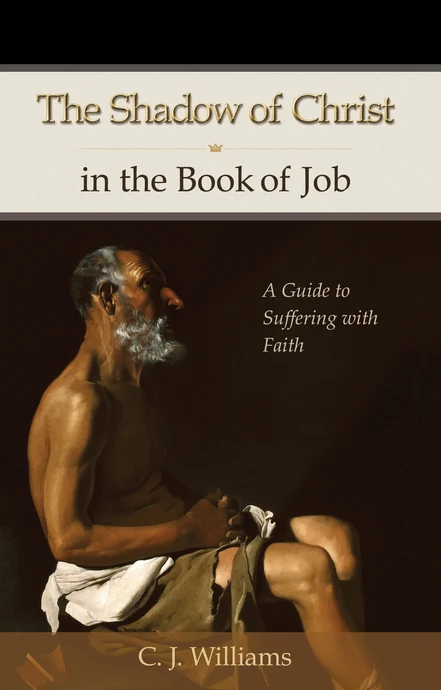
Williams, C. J. The Shadow of Christ in the Book of Job. Crown & Covenant, 2017.
When people claim to see the face of Jesus in a tortilla, and preachers claim to see Jesus on every page of the Bible, we might roll our eyes and think, “The person who sees only what he wants to see is blind to what’s really there.” But before you dismiss C. J. Williams’ Christocentric reading of Job as forcing the NT into the OT, you should read this short, ground-breaking book. He demonstrates the difference between author-intended analogy and reader-driven allegorising. As Williams says, typology is foreshadowing, not aftershadowing.
I used to think the Book of Job was about the problem of evil – how could an all-powerful and all-good God allow evil? Then I was persuaded that Job was more about disinterested righteousness – does anyone love and worship God for who He is, and not just for the gifts He gives? Williams makes the case that Job is about spiritual war and the Genesis 3:15 promise – “What will God do to curtail the power of Satan and subdue the great Adversary who wanders the earth? The ultimate purpose of the trial of Job is to give a divine answer to the rebellious wanderings of Satan. The answer will come in the form of a righteous man who endures great suffering, and who is finally exalted and vindicated at last.”
I’ve struggled with Job for decades, looking for answers to personal questions about suffering, only to walk away with even more questions. Williams opened my eyes to several things I’d not considered. He helped me see how the arguments of Job’s three friends actually make a lot of sense as long as you remain ignorant of one thing: that God has a prophetic purpose for Job’s ordeal, that God is using Job to preach the gospel to all of us. Williams even shows how the three friends unwittingly become part of the typology, as they illustrate what Isaiah 53 prophesies and what Jesus experienced: that the Messiah will be numbered among the transgressors, betrayed, and abandoned by those closest to Him. Williams’ case for Job being a Christ-figure is wide-ranging and persuasive. He helps you appreciate Job as an Adam-figure, a mediator, and a champion for the poor. Why does God’s whirlwind appearance have such an impact on Job? Because it’s not just a theophany, it’s a Christophany. In the whirlwind speeches, Job is encountering the One who will suffer.
Have you ever wondered why God tells the three friends at the end of the book – “You have not spoken of me what is right, as my servant Job has”? You can scrutinize the book and not find the friends saying anything unorthodox about God. Job’s theology is fairly similar to theirs. So how can God say that Job has been speaking correctly about God while they have not? Williams suggests that when Job speaks of his own innocence, he is giving voice to the coming Suffering Servant, so that Job’s talk about himself is Christological and therefore theological. Job’s speeches prepare the way for a Messiah who suffers in spite of being blameless. Job’s friends assume that a perfect man would never suffer, that suffering is only given to the sinful to prompt repentance. They cannot imagine a Messiah who would have to go to the cross. Their Christ would be the Christ of worldly success which Peter and the Jerusalem multitude expected and desired.
You might not agree with Williams’ take on Elihu, and I don’t agree with part of his understanding of the redeemer in Job. But one reason he’s a helpful guide to a difficult part of the Bible is that he’s not an ivory tower academic. He’s an active Reformed Presbyterian pastor with a doctorate in Ancient Near Eastern studies. His way of reading Job might help us read other parts of the Scripture more theologically and thus more faithfully as well.