

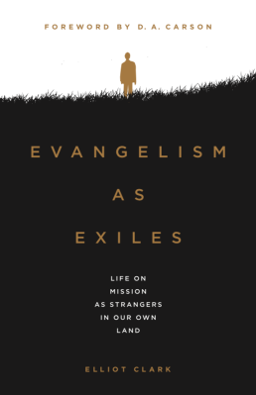
Evangelism as Exiles: Life on Mission as Strangers in Our Own Land, by Elliot Clark (The Gospel Coalition, 2019, 176 pages)
When asked for a list of names that could be used to describe Christians, “exiles” is probably not one that would immediately spring to mind for most people. Yet, in his book Evangelism as Exiles, Elliot Clark maintains that a rediscovery of our identity as “aliens and strangers” (1 Peter 2:11) must be a key ingredient of evangelistic effectiveness in the 21st century.
Clark takes his place in a long line of cross-cultural missionaries whose overseas experiences caused them to take a long, hard look at their “home context”. In his case, he spent six years as a church planter in a closed Central Asian context. It forced him to rethink many of his assumptions about evangelism, since he was ministering in a society where the Christian faith was often viewed with bewilderment, if not outright hostility. This experience led him to reflect deeply on Peter’s references to believers as “elect exiles” (1 Peter 1:1).
The reality is that broad cultural acceptance (i.e., a deep sense of belonging to the cultures we are part of) is true for only a shrinking minority of Christians and would have been seen as something entirely unfamiliar to the earliest Christian believers. This is the context behind the “exile” language used by Peter and the author of Hebrews (Hebrews 11:13). Far from causing us to retreat from society, our identity as exiles should stir us to hope and to a renewed commitment to share our faith.
Clark’s main argument on how exile can motivate and strengthen our evangelism unfolds along the following broad arc: Christian exiles are people who know that their ultimate hope is not in their current circumstances but in the return of Christ. The fact that He will ultimately be victorious releases us from fear, shame, and guilt. It also forces us to be humble, since our message is not based on our status in society. Instead, like “beggars telling other beggars where to find bread”, we can point lost and bewildered people to our true Home. This should be done through verbal proclamation (“declaring His praises”), distinctive lifestyles embodying biblical teaching (Clark calls holiness “an embodied argument of the gospel’s veracity”, p. 115), and sacrificial hospitality.
What I found particularly helpful was Clark’s take on some of the obstacles to evangelism that spring from the fact that many Western Christians prize cultural acceptance and leadership. Within this context, being rejected when we share the gospel could be seen as utterly shameful and something best avoided (through not sharing the gospel in the first place!). On the other hand, those who know that they are “aliens and strangers” realise that at least some people will find their message strange, or even offensive, and are therefore prepared for apparent rejection as part of the process through which God is working to sovereignly call people to Himself.
It should be noted that the main focus of Evangelism as Exiles is on personal and family witness. It would be interesting to see its principles being worked out in terms of the evangelistic work of a local church, but this was evidently beyond the scope of Clark’s book. Be that as it may, it will provide plenty of food for thought for those who are keen to grow in their confidence and ability to share their faith in an increasingly hostile society. I am confident that reading this book will not only spark some good ideas as we think about our own witness but will also kindle a renewed zeal for the task with which we have been entrusted while we live as strangers until our Lord’s return.